

There are places for which tourists specifically buy a ticket to the other side of the world. And there are places you stumble upon completely by chance — simply by turning off a busy street or deciding to walk along the river. And it is often these places that become the most vivid memories of a trip. Woldenberg Park is exactly such a place.
This park cannot boast centuries of history, grand palaces, or famous architectural monuments. Its main treasure is a very special atmosphere. Here you can feel the true rhythm of New Orleans, see the majestic Mississippi in all its beauty, hear the distant horns of river vessels, and briefly forget the city’s hustle and bustle.
Located right on the banks of the great Mississippi River, Woldenberg Park has long become one of the favorite recreation spots for New Orleans residents and a must-stop for travelers. People come here for morning runs, have picnics, watch sunrises and sunsets, walk with children, or simply sit on a bench for a few minutes to observe the slow movement of enormous ships. For locals, the park has long been part of everyday life, while for tourists it is an opportunity to see the city from a different perspective, away from the usual bustle of popular streets. From here, some of the best views open up over the wide Mississippi, passing paddle steamers, modern cargo ships, and the famous Crescent City Connection bridge. Every few minutes the scenery changes: tugboats with barges pass along the river, sightseeing boats and ocean-going vessels appear, and on the opposite bank you can see districts that rarely make it into tourist routes.
Despite its calm atmosphere, the park is located right in the very center of activity. Just a few minutes on foot separate it from the French Quarter, Jackson Square, the legendary Café du Monde, the Riverwalk shopping complex, and other iconic attractions of New Orleans. Thanks to this location, a walk through Woldenberg Park can easily be combined with a visit to the historic center, a river cruise on the Mississippi, or a culinary journey through the city’s best restaurants. Today, Woldenberg Park is considered one of the symbols of New Orleans’ modern waterfront. Despite its relatively young age, it has blended harmoniously into the city’s historic landscape and become an example of how a former industrial area can be transformed into a comfortable public space. Here, history coexists with contemporary art, green alleys smoothly transition into a riverside promenade, and the noise of a large port surprisingly blends with a sense of calm.
The park’s special charm lies in its versatility. Some come here for beautiful photos against the backdrop of the Mississippi, others to enjoy the sunset, listen to street musicians, or take a short break between tours. History enthusiasts find monuments and memorials here, photographers enjoy scenic panoramas, and families with children appreciate the spacious walkways and the opportunity to spend a few relaxed hours outdoors. If you are planning a trip to New Orleans, be sure to set aside at least a few hours to explore Woldenberg Park. Even if your itinerary already includes Bourbon Street, the French Quarter, a Mississippi river cruise, or famous jazz clubs, a walk through this park will be a perfect addition to your journey. It is here that you can slow down for a moment, breathe in the fresh river air, and feel the unique atmosphere that makes New Orleans one of the most colorful and unusual cities in America.

Many people are surprised to learn that the Mississippi River level in the New Orleans area is often higher than some of the city’s streets. That is why most of the city is protected by an extensive system of levees and engineering structures.
From the port docks to the heart of the city: the remarkable history of Woldenberg Park
Today it is hard to believe that the place where tourists now stroll leisurely along the Mississippi, have picnics, and watch sunsets looked completely different just half a century ago. Instead of green lawns, there were warehouses, railroad cars rattled through the area, cargo cranes operated, and the riverfront was almost entirely closed off to ordinary residents.
The modern Woldenberg Park did not appear by chance. Its story is a combination of several bold projects, a grand architectural failure, the generosity of one man, and complex engineering solutions that quite literally reclaimed land from one of the most powerful rivers in North America.
- 01. When the Mississippi Belonged Only to the Port
From the very foundation of New Orleans, the Mississippi riverfront was seen exclusively as a strategically important commercial zone. The city quickly became one of the largest ports in the United States, through which cotton, sugarcane, timber, grain, coffee, and many other goods were shipped. Cargo docks, warehouses, railroad tracks, port cranes, freight terminals, and administrative buildings lined the river. Economically, this made perfect sense: every meter of shoreline generated profit. However, there was a downside — residents were effectively cut off from the river. To reach the water, they had to pass through industrial zones, which was not only inconvenient but often impossible. For decades, the majestic Mississippi remained a working tool rather than a place of leisure. By the mid-20th century, architects and city officials increasingly discussed the need to return the waterfront to the people. But the project was difficult: the port remained vital to the city’s economy, and reconstruction costs were estimated at tens of millions of dollars. - 02. An Architectural Dream That Became a Failure
Before the park existed, the site was occupied by one of the most ambitious projects of its time — the Rivergate Exhibition Hall, sometimes mistakenly referred to as the Continental Trade Center. Opened in 1968, the complex was intended to become a symbol of modern New Orleans. The massive building, with its futuristic dome, was designed by renowned architects Nathaniel Curtis Jr. and Arthur Q. Davis. Because of its unusual shape, it was often compared to a spaceship or a giant seashell. At the time of its opening, Rivergate was considered a true engineering marvel. Beneath the enormous concrete dome covering nearly 10 hectares were exhibition halls, conference rooms, concert spaces, international fair venues, and areas for large public events. The project was meant to attract international exhibitions and turn New Orleans into a business hub of the southern United States. However, reality proved less optimistic. - 03. Why Did Rivergate Fail?
There were several reasons. First, expectations were overly optimistic: the city expected far more international exhibitions than actually took place. Second, within a few years, more modern exhibition centers emerged, offering better conditions for event organizers. In addition, the building’s location was not ideal. The massive dome literally blocked access to the river. Instead of a scenic waterfront, residents saw a huge concrete structure occupying a significant portion of the shoreline. Over time, maintaining the complex became less and less profitable. By the early 1980s, the city was already discussing not modernization, but complete demolition. - 04. Why Was Rivergate Demolished?
For many architects, this decision was a shock. Rivergate was considered one of the finest examples of late-1960s American modernism. Many professionals advocated for its preservation and even proposed granting it landmark status. However, city authorities saw things differently. By that time, a large-scale waterfront redevelopment plan was already in progress. The main idea was to restore public access to the Mississippi and create promenades, parks, restaurants, and public spaces. The massive exhibition center simply stood in the way. In the 1990s, Rivergate was ultimately demolished. Today, many architectural historians consider this decision one of the most controversial urban losses in New Orleans. Nevertheless, clearing the site made it possible to complete the modern riverfront and create a continuous public space that now includes Woldenberg Park. - 05. Who Was Malcolm Woldenberg and Why Is the Park Named After Him?
The name Woldenberg Park is connected to a man remembered with great respect in New Orleans. Malcolm Woldenberg was a successful businessman who led the family company Bell Candies, a confectionery manufacturer. However, he became even more widely known as one of Louisiana’s most generous philanthropists. For many years, Woldenberg funded universities, hospitals, educational programs, charitable organizations, cultural projects, and the restoration of public spaces. He believed that successful business should give back to society. - 06. Why the Waterfront?
During numerous trips to Europe, Malcolm Woldenberg noticed a common feature: in many cities, the most beautiful areas were located along rivers. People walked along promenades, relaxed in parks, and sat in cafés overlooking the water. Upon returning home, he asked a simple question: “Why does New Orleans, sitting on one of the greatest rivers in the world, have almost no accessible waterfront?” This idea became the starting point. When the waterfront redevelopment project began, Woldenberg made a significant donation toward the future park. His contribution was so substantial that the park was eventually named in his honor. In interviews, he emphasized that his goal was not prestige, but to leave a place that future generations could enjoy. Today, watching thousands of people walk along its paths, that vision has clearly been fulfilled. - 07. Building a Park on the Mississippi’s Territory
Creating the park was far more complex than simply planting trees and laying paths. The Mississippi is one of the most powerful rivers on Earth. It constantly shifts its course, erodes banks, and transports millions of tons of sediment. Engineers understood that without proper reinforcement, the new park could gradually be destroyed by the current. A large-scale engineering program was carried out before construction began, including:
- Reinforcement of the shoreline with massive concrete structures;
- Creation of a multi-layer erosion protection system;
- Use of stone embankments to dissipate wave energy;
- Soil stabilization in areas prone to subsidence due to high humidity;
- Upgrading of stormwater drainage systems.
Part of the park was effectively built on a reinforced artificial riverbank. Engineers had to account not only for the Mississippi’s current but also for seasonal flooding, fluctuations in water levels, and even the impact of large vessels passing nearby.
In 1988, additional reinforcement work was carried out on sections of the waterfront where signs of soil erosion had appeared. Structural supports were strengthened, and the riverbank protection system was upgraded. These measures helped preserve the park and ensure its long-term stability.
Today, most visitors do not even realize that beneath the neat lawns and walking paths lies a complex engineering system. It has protected Woldenberg Park for decades from one of the most powerful rivers in North America, allowing thousands of people to enjoy daily walks along the legendary Mississippi.
Woldenberg Park is a green riverside promenade in the very heart of New Orleans
One of the main advantages of Woldenberg Park is its prime location. The park sits in the historic center of New Orleans and stretches along the eastern bank of the Mississippi River for nearly two kilometers. Because of this, it has become a kind of connecting link between the city’s most famous attractions. Even if you do not plan to visit the park specifically, chances are your route will naturally lead you here.
On its western side, Woldenberg Park borders the famous French Quarter — the oldest part of the city, with narrow streets, wrought-iron balconies, and atmospheric courtyards. In the opposite direction, the park smoothly transitions into the modern Riverwalk complex, home to shops, restaurants, and river viewpoints. Within just a few minutes’ walk, you can reach many of New Orleans’ key landmarks:
- Jackson Square;
- The historic French Market;
- The legendary Café du Monde;
- Audubon Aquarium;
- Busy Canal Street;
- Spanish Plaza;
- The dock of the famous paddle steamer Steamboat Natchez;
- Mississippi river cruise terminals.
That is why Woldenberg Park is rarely the final destination of a walk. More often, it becomes a pleasant pause between sightseeing stops. Many tourists start their day in the French Quarter, then head toward the river through the park, rest on one of its many benches while watching passing ships, and continue on to the aquarium, Riverwalk, or a river cruise. But location is not the park’s only feature. Despite being surrounded by busy streets and tourist routes, it remarkably preserves a sense of calm. Carefully designed landscaping plays a major role in this atmosphere.
- 01. More Than Lawns: What Plants Grow in Woldenberg Park
At first glance, the park may seem simple: wide lawns, trees, and walking paths. But a closer look reveals that many plants were carefully selected. They are well adapted to Louisiana’s humid subtropical climate, hot summers, high humidity, and occasional Mississippi flooding.
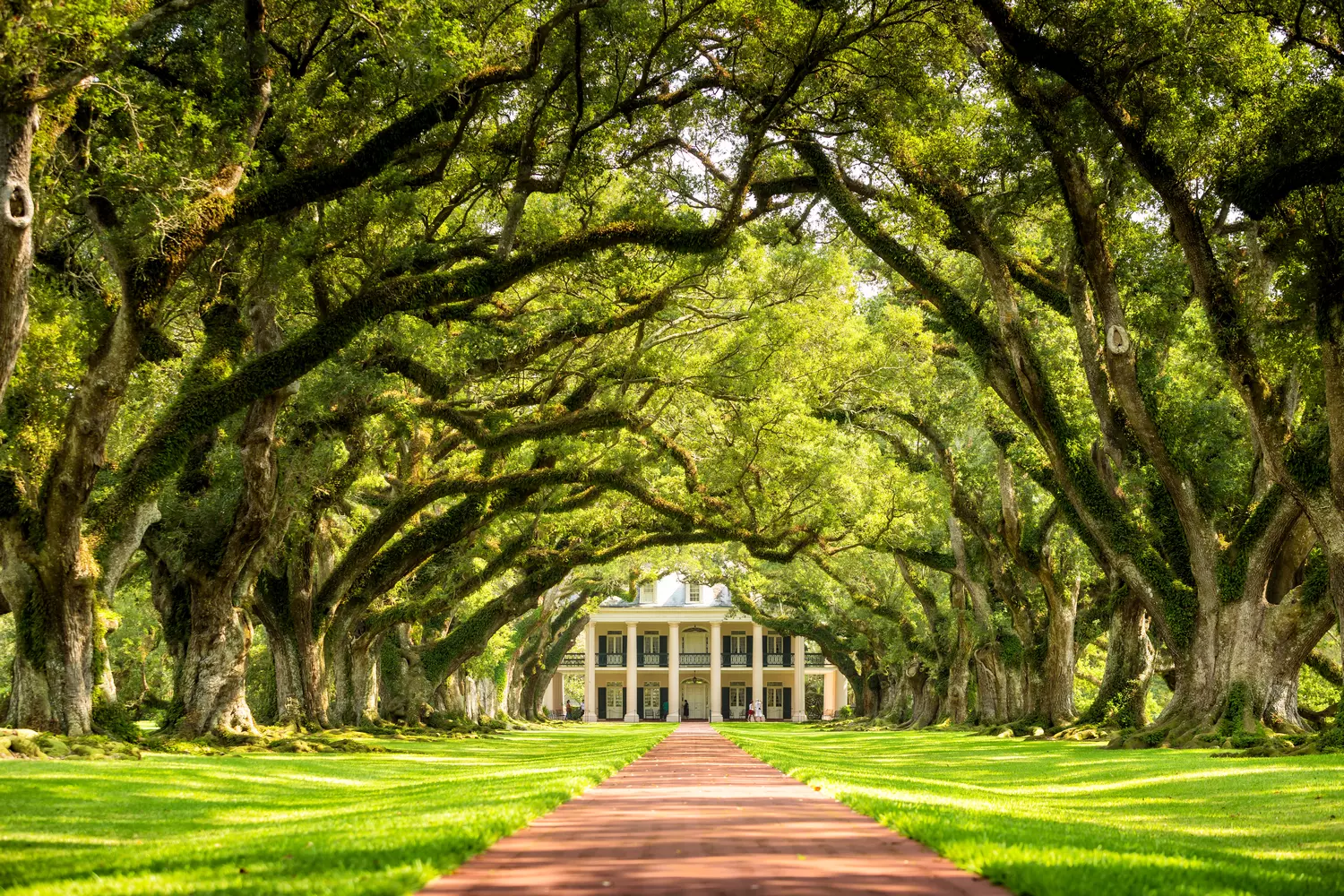
Along the paths grow majestic Live Oaks — one of the symbols of the southern United States. Some of them look ancient, with massive twisting trunks, long horizontal branches, and dense canopies forming natural shaded arches. These oaks are often featured in postcards and photos of New Orleans.
You can also find slender Bald Cypress trees, iconic to Louisiana’s wetlands. In nature, they can grow directly in water, and their unusual “knees” help them breathe in saturated soil. In the park, these roots are less pronounced, but the trees thrive in the moist riverbank environment. Among ornamental plantings, you may notice:
- Southern magnolias with large, fragrant white flowers;
- Sabal palms, well adapted to Gulf Coast climates;
- Crape myrtle with bright summer blossoms;
- Azaleas and camellias that bloom in spring;
- Various ornamental grasses, ferns, and moisture-loving shrubs.
The lawns are maintained in excellent condition year-round. Thanks to the warm climate, greenery lasts much longer than in most parts of the United States. During a walk, you can often feel the light scent of damp soil and river air carried by the Mississippi breeze. This blend of greenery, water, and open space creates the peaceful atmosphere that locals love.
- 02. What Animals Can Be Found in the Park
Although Woldenberg Park is located in the heart of a major city, its wildlife is surprisingly diverse. The Mississippi River makes the park attractive to birds, small mammals, and aquatic life. Visitors most often see seagulls, pigeons, sparrows, and blackbirds. Over the river, gulls and terns regularly circle in search of fish, and during migration seasons, dozens of bird species can pass through the area — a treat for birdwatchers.
Occasionally, herons appear along the shoreline, standing motionless at the water’s edge. If you are lucky, you might spot a great blue heron, one of Louisiana’s most striking birds. In the evening, squirrels often appear on the lawns, moving between trees in search of acorns and other food. - 03. Are There Raccoons Here?
Yes, raccoons are quite common in New Orleans. They live in city parks, riverbanks, and even residential areas. However, spotting them in Woldenberg Park during the day is unlikely, as they are mostly nocturnal. After sunset, they search for food, explore trash bins, and sometimes appear along the paths. While they may look cute, they are wild animals and should not be approached, as they can defend themselves and may carry diseases. - 04. What About Nutria?
One of Louisiana’s most unusual animals is the nutria — a large semi-aquatic rodent introduced in the 20th century for the fur trade. Adults can weigh 7–10 kilograms or more. From a distance, they are often mistaken for small beavers, but they can be distinguished by their long round tail, bright orange teeth, and more elongated snout.
Nutria mainly inhabit swamps and wetland areas around New Orleans. They are rarely seen in Woldenberg Park itself, since the shoreline is reinforced and lacks dense vegetation. However, they can occasionally appear in the water near the banks, especially in the early morning or late afternoon. They are strong swimmers and can hold their breath for a long time, sometimes crossing sections of the river before suddenly disappearing underwater. - 05. Should You Be Concerned About Wildlife?
For most visitors, walking in Woldenberg Park is completely safe. Nearly all local animals avoid contact with humans. The main rule is simple: do not feed or try to touch wildlife.
If you follow basic precautions, your walk becomes not only a chance to enjoy views of the Mississippi but also an opportunity to experience Louisiana’s nature, which exists surprisingly close to the busy historic center of New Orleans. This unique combination of urban architecture, river landscapes, and living nature is what makes Woldenberg Park a place people return to again and again.
More than just a park: why Woldenberg Park has become a favorite place for the residents of New Orleans
For most tourists, Woldenberg Park is one of the most beautiful attractions on the Mississippi riverfront. People come here to take photos, watch river steamboats, relax after walking through the French Quarter, and continue exploring the city. But if you ask the residents of New Orleans what this park means to them, the answer is completely different. For them, Woldenberg Park is part of everyday life — a place to start the morning, meet friends, go for a run along the river, or simply take a short break from the city’s bustle.
Unlike many popular tourist spots, the park does not feel like a man-made attraction designed purely for visitors. There is no sense that everything exists only for tourists. This is exactly why the atmosphere feels so natural. From early morning, the park gradually comes to life. Even before sunrise, the first runners appear. They are followed by cyclists, dog owners, and people who come to watch the sunrise over the Mississippi. Soon after, nearby cafés begin to open, and the paths slowly fill with commuters passing through the park on their way to work. By midday, office workers from the business district arrive to relax. Some come for a quick lunch on one of the benches, others have a small picnic on the grass, and some simply sit with a book, enjoying the river view.
Toward evening, the atmosphere changes again. Families with children, artists with sketchbooks, photographers waiting for the sunset, street musicians, and couples strolling along the water all appear in the park. Despite the constant flow of people, Woldenberg Park rarely feels crowded. Wide paths, spacious lawns, and its elongated shape along the river allow everyone to find a quiet corner. This is exactly what locals appreciate most. The park’s atmosphere is shaped by several elements:
- Wide pedestrian paths with no car traffic;
- Large green lawns;
- Deep shade from mature trees;
- Panoramic views of the Mississippi River;
- A constant river breeze that makes even hot days more comfortable;
- Street musician performances;
- The simple ability to sit and watch the life of a massive river.
Here, one of New Orleans’ defining traits becomes especially clear: the city is never in a hurry. Even in the very center, you can find a place where time seems to move a little more slowly.
- 01. The Most Beautiful Running Route in New Orleans
If you ask local runners to name the best city route, many will immediately choose Woldenberg Park and the adjacent waterfront. The reason is not only the scenery. The route has almost no car traffic, features smooth surfaces, wide paths, and very few steep inclines. There is no need to constantly stop at traffic lights or cross busy intersections.
The main highlight, however, is the scenery. The run begins near the French Quarter, where the first sounds of the waking city can be heard. It then opens up to a panoramic view of the Mississippi River. Over nearly two kilometers, runners are accompanied by constantly changing views: first, paddle steamers and river cruise ships appear; then a wide bend of the river opens up, where massive cargo vessels pass just a few dozen meters from the shore. The route continues toward Spanish Plaza and Riverwalk, where the contrast between historic New Orleans and its modern waterfront becomes especially clear.
During morning runs, you can meet people of all ages — marathon trainees, casual joggers, and dog walkers. Due to high humidity, most athletes finish their workouts before eight or nine in the morning, before the sun becomes too strong. - 02. The Morning Dog Owners’ Club
Another distinctive feature of Woldenberg Park is the large number of dogs. Although there is no dedicated fenced dog area, the spacious paths and lawns make it one of the most popular places for walking pets. Every morning, a small routine naturally forms.
The same people arrive at roughly the same times. While the dogs socialize, their owners talk about neighborhood news, share veterinary advice, discuss upcoming city festivals, and simply chat. For many, it has become a kind of informal morning club. You can see a wide variety of breeds — from small French bulldogs to large Labrador retrievers, golden retrievers, German shepherds, and energetic border collies. Tourists are often surprised by how calm the dogs are; most are well-socialized and used to crowds. - 03. Anglers Against a Backdrop of Skyscrapers
One of the most unexpected sights in Woldenberg Park is people fishing in the middle of a major city. At first glance, it seems unlikely: tourist streets are bustling nearby, cruise ships are docked along the river, and modern buildings rise in the background. Yet along the waterfront, anglers are a regular sight.
The Mississippi may look muddy, which often makes visitors doubt that it contains much life. In reality, the color comes from the enormous amount of silt and sediment the river carries. Far from being lifeless, the Mississippi is one of the richest freshwater fishing rivers in North America. Common catches include various types of catfish, freshwater drum, gar, carp, and sunfish. Some catfish grow to impressive sizes, weighing dozens of kilograms.
For local anglers, the process matters more than the catch. Many come not for fish, but for a few peaceful hours by the water. Sometimes an unusual scene unfolds: a fisherman sits just meters away as a historic paddle steamer passes, followed by a massive ocean-going cargo ship, while jazz drifts in from the French Quarter in the background.
This combination of city life, history, nature, and one of the world’s greatest rivers makes Woldenberg Park truly unique. That is why the people of New Orleans keep coming back — not for the landmarks, but for a feeling that is hard to find anywhere else.
Art by the water: the sculptures and amphitheater of Woldenberg Park that change the way you perceive the Mississippi River
Despite its elongated shape, Woldenberg Park does not feel monotonous. On the contrary — it is one of those rare urban parks where the landscape seems to “shift” every few hundred meters: new views of the river open up, sculptures appear, the rhythm of the walk changes, and the space gradually reveals itself from different angles.
It is easy to lose track of time here. You can walk along the waterfront and suddenly stop not because you are tired, but because an unexpected art piece or a particularly striking view of the Mississippi appears in front of you.
- 01. An Open-Air Gallery: Sculptures Along the River
Woldenberg Park is often described not only as a waterfront promenade but also as a kind of open-air gallery. And that is exactly what it is. The artworks here are not hidden in museum halls — they are integrated into the urban space and literally “live” alongside the river. Most sculptures are placed to interact with the surrounding landscape. They do not simply stand against the water — they seem to be in dialogue with it. During a walk, you can encounter:
- Memorial monuments dedicated to the history of New Orleans;
- Abstract compositions made of metal and stone;
- Sculptures connected to the themes of the river and navigation;
- Memorial objects dedicated to the city’s people.
But there is one artwork that consistently draws the attention of all visitors — even those who are usually indifferent to contemporary art.
- 02. “Reflections”: A Face Emerging from the Water
One of the park’s most recognizable and widely discussed sculptures is the monumental work “Reflections”. It is a massive human head partially emerging from the ground right at the edge of the waterfront. Most visitors have the same first impression: it looks as if the sculpture is rising directly from the Mississippi River. That is precisely its effect.
The artist conceived the piece as a symbol of reflection and an inner dialogue between humans and the surrounding world. However, within the context of Woldenberg Park, it gains additional meaning. The sculpture appears as if:
- A person is rising from the depths of the river;
- The city’s past is surfacing again;
- The memory of New Orleans’ port history is returning to the present;
- The river itself becomes part of the human form.
This visual effect is enhanced by the sculpture’s placement. The head is partially embedded in the ground and faces the Mississippi, as if observing the constant movement of water and ships. “Reflections” is especially striking at different times of day: in the morning, soft light emphasizes its texture; during the day, it feels more monumental and heavy; at sunset, it takes on a nearly mystical mood; at night, under artificial lighting, the face seems almost alive against the dark river. It is no surprise that this is one of the most photographed spots on the waterfront.
- 03. Sculptures as Part of the Route, Not Separate Objects
The distinctive feature of Woldenberg Park is that art objects are not placed in a separate “art zone.” They are embedded into the walking route itself. This means visitors do not “go to see sculptures” — they simply walk along the promenade and encounter them along the way. This approach creates a natural sense of interaction with the city. Art is not separated from everyday life; it becomes part of it. Sometimes compositions appear unexpectedly — around a corner, next to a bench, or directly against the backdrop of a passing river vessel. - 04. The Amphitheater Staircase: Where the City Meets the River
One of the park’s most interesting architectural features is the stepped descent to the water, designed as an amphitheater. At first glance, it looks like a simple staircase leading closer to the Mississippi. In reality, it serves several functions — both aesthetic and engineering.
- Engineering role: flood protection
New Orleans is a city that constantly lives in dialogue with the river. The Mississippi’s water level changes, and flood risk is always considered in waterfront design. The stepped amphitheater structure plays an important protective role: it distributes water pressure during rising river levels, reduces wave force near the shore, helps stabilize the waterfront structure, and forms part of the broader levee system. It is not just decorative — it is a key piece of urban engineering. - Social function: a natural stage by the river
Over time, the amphitheater has also become a social space. It is one of the liveliest spots in the park. People sit on the steps watching the river, enjoy sunsets, listen to street musicians, take photos, hold informal gatherings, or have small picnics. The steps function like natural theater seating, while the Mississippi becomes the stage. A massive container ship may pass by, followed by a historic paddle steamer, while the sun sets on the opposite bank — all unfolding like a live performance that cannot be repeated. - The best sunset spot in the park
If you ask locals where the best place to watch the sunset in Woldenberg Park is, many will point to the amphitheater. The reason is simple: it combines open river horizons, unobstructed sunset views, reflections on the water, passing ships forming silhouettes, and the gradual transition of the city into its evening rhythm. The steps fill with people, but never feel crowded. Some watch in silence, others take photos, others speak quietly. The sunset here feels less like an event and more like a natural part of city life.
The sculptures, amphitheater, and overall layout of the waterfront create a rare impression: the city does not separate art, nature, and everyday life, but merges them into a single space. Woldenberg Park is not just a park and not just a promenade. It is a place where the river becomes a stage, art becomes part of the journey, engineering is hidden beneath the landscape, and an ordinary walk turns into a small performance.
That is why even a short visit to this stretch of waterfront often leaves a stronger impression than many of the city’s more “famous” attractions.
Woldenberg Park: what to see on the waterfront where the Mississippi River becomes the city’s main exhibit
Woldenberg Park often looks like a simple riverside promenade — a green strip along the river where you can take a walk, sit on a bench, and snap a few photos. But this impression is misleading. In reality, it contains an astonishing number of meanings, views, and stories that unfold gradually, step by step.
This park does not demand haste. It is designed in such a way that each new section seems to “pick up” the previous one: the river gives way to sculptures, sculptures to panoramas, panoramas to music — and together they form a complete feeling of a city living at its own unique rhythm.
- 01. The Mississippi Riverfront — New Orleans’ Main Stage
The first thing that captures attention in Woldenberg Park is the river itself. The Mississippi here does not look like a decorative element. It is a powerful, wide waterway that quite literally shapes the city’s identity. In this section, the river spans several hundred meters, creating an almost maritime sense of space. During a walk, you cannot help noticing how the “storyline” on the water constantly changes:
- Massive container ships slowly pass along the shipping channel;
- Tugboats push long chains of barges;
- River cruise vessels move calmly along the shore;
- Historic paddle steamers sound their horns, echoing the 19th century;
- Smaller boats and service craft cross the river in different directions.
For tourists, the contrast is especially striking: in the very center of a historic city runs a true “industrial highway” carrying vessels of global scale. At times it feels less like a river and more like a living industrial ocean that never stops moving.
- 02. Crescent City Connection — A Bridge That Becomes Part of the Landscape
One of the most striking elements of the panorama is the Crescent City Connection bridge. It is not just a transport route but one of New Orleans’ visual symbols. Its two parallel spans stretch across the Mississippi, creating a strict geometry that sharply contrasts with the natural curve of the river. During the day, the bridge appears as a powerful piece of engineering — functional and restrained. But toward evening, its mood changes completely. As the sun begins to set, something happens that draws photographers in:
- The metal structure darkens and turns into a silhouette;
- The water reflects orange and golden tones of the sky;
- Long bands of light appear on the river;
- Passing vessels become moving shadows.
At that moment, the bridge is no longer just infrastructure. It becomes part of a cinematic frame that can never be exactly repeated.
- 03. Paddle Steamers — Living History Against a Modern City
Another essential part of a walk through the park is watching river steamboats. Although these are modern sightseeing vessels, their design evokes the 19th century. White hulls, tall chimneys, and enormous paddle wheels create the impression that time has slightly slowed down here. When such a steamer passes by glass skyscrapers and modern bridges, a rare visual contrast emerges: the past moves along the river, the present stands on the shore, and both exist simultaneously. Even if you do not plan a Mississippi cruise, watching these boats from the riverbank becomes an experience in itself. - 04. An Open-Air Gallery: Art Embedded in the City
Woldenberg Park cannot be seen only as a natural space. It is also an artistic environment where sculptures and memorials are integrated into the walking route. There is no separate “art zone” here. Each sculpture is placed so naturally within the landscape that it feels like it has always belonged there. The themes vary widely: the history of New Orleans, the development of river trade, memory of significant events and people, and abstract compositions inspired by water and movement. Interestingly, many works reveal their full meaning only in relation to the river — the same monument can feel entirely different against calm morning water or a glowing sunset sky. - 05. The Immigrant Monument — A Point of Human Stories
One of the park’s most emotionally powerful sculptures is dedicated to the people who arrived in New Orleans in search of a new life. Historically, the city served as a “gateway” to the United States. Through its port passed thousands of immigrants from Europe, Latin America, and other regions. For many, this city was their first step on American soil. The monument reflects this quietly, without grandeur. It does not dominate the space but invites reflection. Set against the sound of the river and passing ships, it becomes a symbol of the human stories behind every great city. - 06. Memorials and Urban Memory
Throughout the park, you can encounter small memorials dedicated to sailors and river workers, regional military history, public figures, and important events in Louisiana’s past. Their distinctive feature is how seamlessly they blend into the environment. They do not stand out as separate stops but instead become part of the walking experience. Sometimes you may not even immediately realize that you are looking at a monument — so naturally it fits into the landscape. - 07. Music on the Waterfront — The City’s Living Soundtrack
New Orleans cannot be imagined without music, and Woldenberg Park reflects this in a particularly vivid way. Music here is not confined to stages or festivals. It appears spontaneously along the waterfront. You may hear traditional jazz, blues improvisations, funk and soul, gospel, or contemporary street performances. Musicians often gather small groups of listeners, and the park instantly turns into an open-air concert hall. Against the backdrop of the river and passing ships, these performances feel especially alive — not as a show, but as a natural part of everyday city life.
The main feature of Woldenberg Park is that it does not push you along a route. Instead, it slows you down. It naturally shifts you from “just walking” to observing: the river, the people, the music, the changing light. And that is where its value lies — the park does not demand attention, but it constantly holds it. Each element — the river, the bridge, the sculptures, or the music — becomes part of a single urban landscape that cannot be seen all at once, but can be experienced step by step.
Woldenberg Park in the rhythm of the city: festivals, music, and life on the banks of the Mississippi River
Although Woldenberg Park is most often perceived as a quiet riverside promenade, it is actually one of New Orleans’ key public spaces. Throughout the year, it regularly transforms into a large open-air stage, hosting festivals, concerts, city celebrations, and large-scale events.
Here, two roles blend in an unusual way: in the morning it is a peaceful place for jogging and walking, while in the evening it becomes a lively venue filled with music, light, and people.
- 01. A Park That Knows How to Transform
The main characteristic of Woldenberg Park is its versatility. Thanks to its long, narrow layout, wide lawns, and direct access to the river, the space can easily be adapted for different types of events: concert stages, festival zones, street food areas, relaxation spots with blankets, temporary pavilions, and art installations. On a regular day, you hear the sound of the river and footsteps of passersby. During events, however, the park fills with music, voices, food aromas, and the atmosphere of a large city celebration. The most active season is spring and autumn, when Louisiana’s climate is most comfortable and urban life moves outdoors. - 02. French Quarter Festival — The Heart of Musical New Orleans
One of the most important events partially held in Woldenberg Park is the French Quarter Festival. It is the largest free music festival in the state, attracting hundreds of thousands of visitors every year. Unlike closed venues, the music literally “spills” across the entire city center — from the streets of the French Quarter to the Mississippi riverfront. During these days, Woldenberg Park becomes one of the festival’s key stages. Visitors can hear traditional New Orleans jazz, blues improvisations, funk and soul, gospel choirs, and contemporary bands. But the festival is not only about music. Food zones appear throughout the park, offering local cuisine — from Creole snacks to traditional Louisiana seafood dishes. The atmosphere feels like a massive street celebration where there are no spectators in the usual sense, only participants. - 03. July 4th: When the Mississippi Becomes a Fireworks Stage
Another major event is Independence Day. On July 4th, Woldenberg Park becomes one of the best viewing points for the New Orleans fireworks display. By evening, the riverfront gradually fills with people. Families, tourists, and groups of friends claim spots along the river long before the show begins. As darkness falls, the main spectacle starts:
- Dozens of fireworks burst over the Mississippi;
- The lights reflect in the dark water, creating a mirrored effect;
- Silhouettes of bridges and vessels become part of the composition;
- Music and the sound of the crowd fill the night air.
What makes this location special is that the fireworks are not an isolated show — they become part of a living cityscape. The river, ships, and sky form a single visual canvas.
- 04. Summer Open-Air Concerts
During the warmer months, the park regularly hosts free music evenings. These are not large festivals but smaller, more intimate — yet equally atmospheric — events. You can hear jazz ensembles, brass bands, Louisiana folk groups, chamber music, and local contemporary bands. The key difference is the lack of formality. People do not sit in rows like in a concert hall. Instead, they spread out on the grass, bring blankets and drinks, talk, dance, and gradually become part of the musical environment. Against the backdrop of the Mississippi, even a simple performance feels freer, more natural, and more alive. - 05. Nearby Food Scene: From Iconic Desserts to Creole Cuisine
One of the advantages of Woldenberg Park is its location. Within just a few minutes’ walk, there is a wide selection of cafés and restaurants, making it easy to combine a stroll with a culinary experience.
- Café du Monde — the taste of New Orleans
One of the most famous nearby spots is the iconic Café du Monde. It is known for its beignets — airy fried pastries generously covered in powdered sugar — and chicory coffee, a signature of the city. Lines are almost always present, but for many visitors, waiting is part of the experience itself. - Riverwalk — dining for every taste
Just steps from the park lies the Riverwalk complex, offering a convenient option for those who want a quick and easy meal. It features a wide range of cuisines: American, Mexican, Asian, seafood, steaks, desserts, coffee, and casual snacks. This makes it especially suitable for families or groups with different preferences. - French Quarter — the gastronomic heart of the city
A short walk further leads to the French Quarter, where dining becomes a cultural experience. Here you can try classic Louisiana dishes such as gumbo, jambalaya, fresh oysters, shrimp and crawfish, Creole specialties, and traditional Cajun recipes. Each restaurant is more than just a place to eat — it is part of the city’s living history, with recipes passed down through generations.
The secret is simple: everything happens against the backdrop of real city life. There is no sense of separation from the environment — the river, ships, bridges, and urban sounds become part of every event. That is why festivals, concerts, and celebrations in Woldenberg Park are not perceived as isolated happenings, but as a natural continuation of New Orleans itself — a city that always lives at the intersection of music, water, and movement.
Fort Zachary Taylor State Park in Key West
Woldenberg Park in different seasons and walking tips: how to truly experience the Mississippi River waterfront
Woldenberg Park is not a place with a fixed mood. It changes with the seasons, the light, and the rhythm of the city, which is why every visit feels slightly different. Sometimes the riverfront feels calm and almost empty, sometimes it is filled with music and tourists, and at other moments it turns into a quiet waterside space where the Mississippi itself becomes the main “event.”
To experience the park the way locals do, it is important to consider not only the season, but also the time of day, the weather, and even your own walking pace. This is precisely what makes it special — it does not reveal itself all at once, but unfolds gradually through movement.
- 01. Woldenberg Park through the seasons: when the Mississippi riverfront truly comes alive
Woldenberg Park is open year-round, but it feels completely different depending on the season, time of day, and even the weather. This is not a park that looks “the same” at any time — it evolves with the city, the river, and the light. Sometimes it is a quiet morning promenade, sometimes a hot summer space filled with musicians and tourists, and sometimes a cinematic sunset scene where the Mississippi becomes the main actor.
- Spring — the best time for a first visit
Spring is considered one of the most comfortable and beautiful periods to visit Woldenberg Park. Temperatures become mild, humidity drops, and the city comes alive after the cooler winter months. Trees fill with fresh greenery, the air feels lighter, and the riverfront takes on a sense of renewal and movement. This is the time when the park feels especially “open”: vegetation is vibrant, river traffic increases, and festivals bring extra energy to the city. Spring is ideal for unstructured walking — simply moving along the water, stopping occasionally to watch passing ships and shifting light. It is no coincidence that many postcards and travel photos are taken in this season — the park looks at its most balanced and vivid. - Summer — energy, heat, and life by the river
Summer in New Orleans is a season of contrasts. On one hand, there is high heat and humidity; on the other, intense city life. Temperatures often exceed 30°C (86°F), so visiting Woldenberg Park in summer requires a different approach. The best times are early morning, when the city is just waking up; evening, when the sun begins to set over the river; and night, when the waterfront fills with lights and music. Midday walks are possible but require preparation: water, sun protection, and shade are essential. Still, summer has one major advantage — the river. Constant breezes from the Mississippi make even the hottest days more bearable, especially along the open waterfront areas. In summer, the park becomes especially lively: musicians, tourists, families, and runners all blend into a continuous urban flow. - Autumn — perfect balance and calm
Many locals consider autumn the best time to visit Woldenberg Park. The heat gradually fades, the air becomes drier and more comfortable, and tourist crowds decrease slightly. This is when the park feels most balanced: less heat, more comfort, more space for slow walks, softer light over the river, and especially striking sunsets. Autumn is ideal for spending long periods here — reading, walking, watching ships, or simply sitting by the water. It is the season when the park feels most “urban” in the best sense — not a tourist attraction, but part of everyday city life. - Winter — a quieter New Orleans
Winter in New Orleans is mild, with no harsh frosts or snow in the typical northern sense. Even in January, it is often comfortable to walk in a light jacket or sweater. As a result, winter transforms Woldenberg Park into a great place for those who want to see the city with fewer tourists. There are shorter lines at attractions, more space along the riverfront, and a calmer atmosphere overall. Visually, the park is less vibrant, but it becomes more intimate and peaceful.
- 02. How to make your visit comfortable: important details
Even a short visit can be significantly improved with a bit of preparation.
- Comfortable shoes are essential
Woldenberg Park may look compact on a map, but in reality a walk easily turns into several kilometers, especially if you continue toward the French Quarter or Riverwalk. Comfortable sneakers or walking shoes are best. This is particularly important in summer, when heat increases fatigue. - Sun and southern climate
Most of the riverfront has little natural shade from buildings. As a result, the sun feels stronger here than in the city’s narrow streets. From May to September, it is especially important to carry water, wear a hat, use sunglasses, and apply sunscreen. Even a short walk can easily become longer than expected under the southern sun. - Do not rush — the key rule of the park
Woldenberg Park is not meant for a quick walkthrough. It can be crossed in 10–15 minutes, but doing so removes the most important part — the sense of space and rhythm. It is better to sit by the water, watch the ships, listen to street musicians, take a break between sightseeing stops, and simply observe the river. These are the moments that stay in memory the longest.
- 03. If you are visiting with children
The park is well-suited for family visits. It is safe, spacious, and easy to navigate with strollers. Children have room to move freely, while parents can relax without worrying about heavy traffic or dangerous areas. Nearby attractions also make it convenient for families: Audubon Aquarium, riverboat cruises, Riverwalk with cafés and shops, French Market, and dessert and ice cream spots. This makes it easy to combine a park visit with a full family day in downtown New Orleans.
Woldenberg Park is a place where the season matters, but does not fully define the experience. What matters more is the light, the river, the wind, the rhythm of the city, and your own state of mind. That is why every visit feels slightly different — even when the route stays the same.
What to see near Woldenberg Park: top attractions within walking distance
One of the key advantages of Woldenberg Park is its location. It is not an isolated green space, but part of the living tourist center of New Orleans. In almost any direction, you can walk for just a few minutes and reach another major landmark.
That is why the park often serves not as the destination of a route, but as a connecting point: a place to rest between walks, take a break, and decide where to go next.
- 01. Jackson Square — the heart of historic New Orleans
Just a few minutes on foot from the riverfront, you arrive at Jackson Square, one of the most famous squares in the United States. It immediately sets the atmosphere of the old city:
- Street artists draw portraits on the spot;
- Musicians play jazz and blues;
- Fortune tellers and performers create a theatrical atmosphere;
- Colonial-era buildings surround the square.
The main architectural landmark of the square is St. Louis Cathedral, one of the oldest Catholic cathedrals in the United States. Its white façade and three pointed towers have become one of the visual symbols of New Orleans. Jackson Square is where the city’s cultural blend of eras and styles becomes especially visible.
- 02. Audubon Aquarium — an underwater world of the Gulf of Mexico
For families or anyone looking for a change of atmosphere, the Audubon Aquarium of the Americas is located nearby. It is a modern aquarium featuring species from the Gulf of Mexico, the Mississippi River ecosystem, tropical marine life, sharks, rays, jellyfish, and exotic fish from around the world. Special emphasis is placed on local nature, allowing visitors to see the underwater life of Louisiana that is usually hidden from view. It is a calm, cool alternative to walking through the hot city. - 03. Riverwalk Outlets — shopping with a view of the Mississippi
Right along the waterfront lies Riverwalk Outlets, a shopping and entertainment complex seamlessly integrated into the riverfront. It is a convenient stop if you want to:
- Shop from well-known brands;
- Have a meal overlooking the river;
- Relax in air-conditioned indoor spaces;
- Escape the summer heat.
Restaurants and cafés offering a variety of world cuisines are available here, and large panoramic windows allow you to continue enjoying views of the Mississippi even while shopping.
- 04. Steamboat Natchez — a journey into the paddle steamer era
One of the most atmospheric attractions near the park is the paddle steamer Steamboat Natchez. It is not just a sightseeing cruise but a true symbol of the city. During a cruise on the Mississippi, you can:
- Listen to live jazz on board;
- See the working port of New Orleans;
- Experience the atmosphere of the 19th century;
- Sail past the historic city center from the water.
Evening cruises are especially popular, when the city lights begin to glow and the sunset reflects on the river. For many visitors, this boat ride becomes the most memorable part of their trip.
- 05. Canal Street — a boundary between eras and styles
Canal Street is one of the city’s main thoroughfares and symbolically divides the French Quarter from the modern business district. It is a place of contrasts:
- Historic streetcars next to modern hotels;
- Heritage buildings beside glass skyscrapers;
- Busy intersections and quiet side streets.
A walk along Canal Street allows you to experience the transition from historic New Orleans to its contemporary side in just a few minutes.
- 06. Spanish Plaza — a quiet riverfront spot
Not far from Woldenberg Park lies Spanish Plaza, a peaceful square with a fountain and views of the Mississippi. It is noticeably calmer than the main tourist areas. It is a pleasant place to sit on a bench, take photos of the river, have a light outdoor snack, or wait out the midday heat. The central fountain symbolizes the friendship between the United States and Spain, reflecting the region’s layered history. - 07. Audubon Butterfly Garden and Insectarium — an unexpected world of nature
Another nearby attraction is the Audubon Butterfly Garden and Insectarium. This interactive museum is dedicated to insects and ecosystems: tropical butterflies, rare beetles, and species from around the world, along with educational exhibits about Louisiana’s natural environment. It is especially interesting for children and anyone curious about the “hidden side” of urban nature. - 08. Louis Armstrong Park — a little further, but worth it
A short walk from the riverfront brings you to Louis Armstrong Park, a green space dedicated to the jazz legend. It features sculptures and memorials, Congo Square — a historic site of African American culture — along with quiet paths and ponds. The park is particularly important for understanding the musical and cultural history of New Orleans.
The main advantage of this part of the city is the incredible density of attractions. Within just a few minutes’ walk, you can access the historic center, the Mississippi riverfront, museums and aquariums, restaurants and cafés, river cruises, and lively music streets.
That is why Woldenberg Park often becomes not the final destination of a route, but its heart — a place to begin exploring New Orleans and to return to between walks.
Discover New Orleans with American Butler
The most interesting trips are rarely limited to visiting popular landmarks. A true experience of a city begins when the itinerary is tailored to your interests, your travel pace, and your desire to see not only well-known places, but also hidden corners that most tourists never discover.
American Butler will help you organize your trip to New Orleans in a way that ensures maximum impressions without unnecessary hassle. We will design an optimal itinerary, advise which attractions are best combined in a single day, and assist with transfers, guided tours, hotel bookings, and other travel services.
Whether it’s a walk through Woldenberg Park, exploring the French Quarter, a cruise along the Mississippi River, or a culinary journey through the best restaurants of Louisiana — with American Butler your trip will be comfortable, rich in experiences, and truly memorable.
Leave the logistics to us, and simply enjoy the atmosphere of New Orleans and discover America with pleasure.
Share